
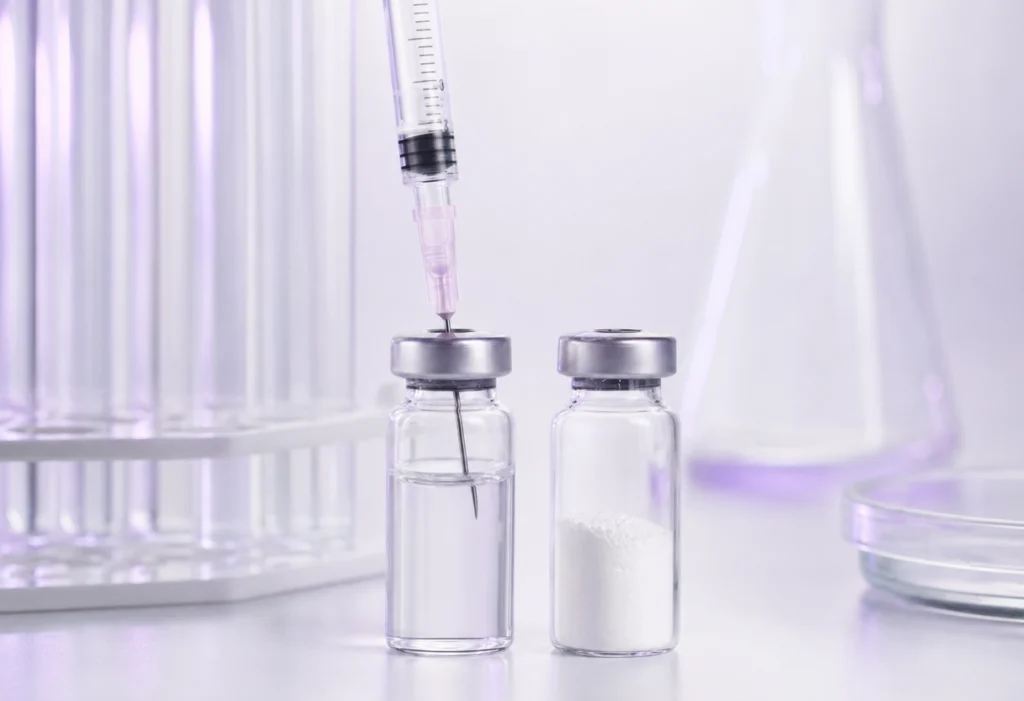
Lyophilized peptides arrive as a stable freeze-dried powder, but almost every analytical workflow requires them in solution. Reconstitution — dissolving the powder in an appropriate diluent — is a simple step that is easy to get wrong. This guide covers the essentials for laboratory settings.
Why Bacteriostatic Water
Bacteriostatic water is sterile water containing 0.9% benzyl alcohol. The additive inhibits bacterial growth, which allows a single vial of diluent to be used for multiple withdrawals over several weeks without compromising sterility. For single-use preparations, plain sterile water is an alternative; for anything stored and re-sampled, bacteriostatic water is the standard choice.
Basic Technique
- Allow both vials to reach room temperature before starting.
- Wipe septa with an alcohol swab and let them dry.
- Draw the intended volume of diluent and introduce it into the peptide vial slowly, directing the stream against the glass wall rather than onto the powder.
- Never shake the vial. Swirl gently or let it stand until the solution is fully clear.
Concentration Math
Concentration is simply mass divided by volume. A 10mg vial reconstituted with 2ml of diluent yields 5mg/ml. Choosing a round-number volume makes later dilution calculations easier and reduces pipetting error.
After Reconstitution
Label the vial with the date, diluent, and concentration. Store reconstituted peptides refrigerated at 2–8°C and use them within the window supported by stability data for the specific compound. Avoid repeated temperature cycling — draw what is needed and return the vial to the refrigerator promptly.
Research Use Only
All compounds discussed are intended strictly for laboratory research applications. They are not for human or veterinary use of any kind.